ISO/IEC 17025 accreditation is how a PV laboratory proves that its results are competent, impartial and traceable. Avalon ST and its sister company Pasan supply the solar simulators behind many accredited laboratories, from university institutes such as UNSW Sydney to the calibration and certification labs that rely on Pasan reference systems, which serve as the reference for more than 100 laboratories worldwide.
Pasan has published a step-by-step guide to passing ISO/IEC 17025 for PV module measurement. This article summarises the path and looks at what changes when the simulator is full-LED.
The path in short
- Define the scope: quantities (Pmax, Isc, Voc, fill factor at STC), standards (IEC 60904-1, -2, -7, -9, -10, IEC 60891), module sizes and technologies.
- Build an unbroken traceability chain for the reference device, the electronic load’s voltage and current channels, temperature sensors and spectral data.
- Characterise the simulator to IEC 60904-9 edition 3 and repeat at defined intervals.
- Validate the method for the devices in scope, including capacitive HJT, TOPCon and tandem modules.
- Write a GUM uncertainty budget that covers every contribution.
- Assure validity with control modules, intermediate checks and interlaboratory comparisons.
- Keep training, raw data and calibration states on record, and run internal audits and a management review.
- Apply to the national accreditation body and close the findings of the on-site assessment.
What a full-LED simulator changes
- A spectrum that does not age: LEDs do not drift the way an arc lamp does, so intermediate spectral checks confirm a stable state rather than chase lamp ageing.
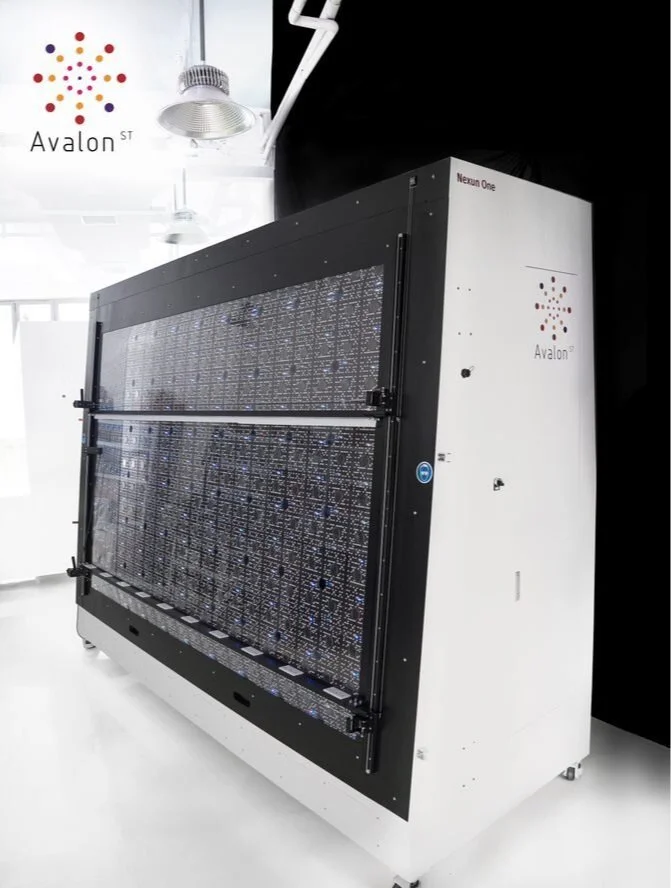
- Per-channel control: on the [Nexun ULTRA](/products/nexun-ultra), each of 37 wavelengths is driven independently, so the spectrum can be verified and tuned band by band against IEC 60904-9 edition 3.
- Long single-sweep pulses: 500 ms on every long-pulse Nexun measures capacitive devices in one sweep, which simplifies method validation and removes a transient term from the uncertainty budget.
- No consumables: a light engine guaranteed for 3,000,000 flashes means no lamp changes that would trigger re-characterisation.
Calibratable by design
Avalon ST designs and builds its light engines, drivers, load and acquisition electronics in-house and produces its electronic boards on the group’s own SMT line, so every measurement channel is documented and can be calibrated externally, on the calibration chain shared with Pasan and traceable to METAS under ISO/IEC 17025. See built in-house and how to check that a calibration certificate is genuine.
Preparing for accreditation on an LED system, or moving an accredited scope from xenon to LED without losing your history? Talk to us.