 Electroluminescence Imaging
High-efficiency modules are capacitive. TOPCon, heterojunction and perovskite-on-silicon devices store charge, so when the voltage across them changes, part of the current goes into charging or discharging that capacitance instead of flowing into the load. Sweep the voltage fast and the measured current lags behind the real one: the I-V curve is distorted, the forward and reverse sweeps disagree, and the power on the label is wrong.
Where Dynamic IV comes from
Dynamic IV was developed in 2011 by Damien Etienne and Christos Monokroussos and published the following year:
C. Monokroussos, D. Etienne, K. Morita, C. Dreier, U. Therhaag, W. Herrmann, “Accurate Power Measurements of High Capacitance PV Modules with Short Pulse Simulators in a Single Flash”, 27th European Photovoltaic Solar Energy Conference and Exhibition (EU PVSEC), 2012, pp. 3687 to 3692. DOI 10.4229/27thEUPVSEC2012-4BV.4.41
The paper names the method Dynamic IV (t-IV): time becomes an additional variable of the measurement, so that every point of the I-V curve gets the time it needs to relax from capacitive effects, and the whole curve is still taken in a single flash. On three commercial high-capacitance modules, the maximum power measured this way agreed with steady-state measurements within 0.2 %.
How it works
- The voltage moves in steps, not in a continuous ramp.
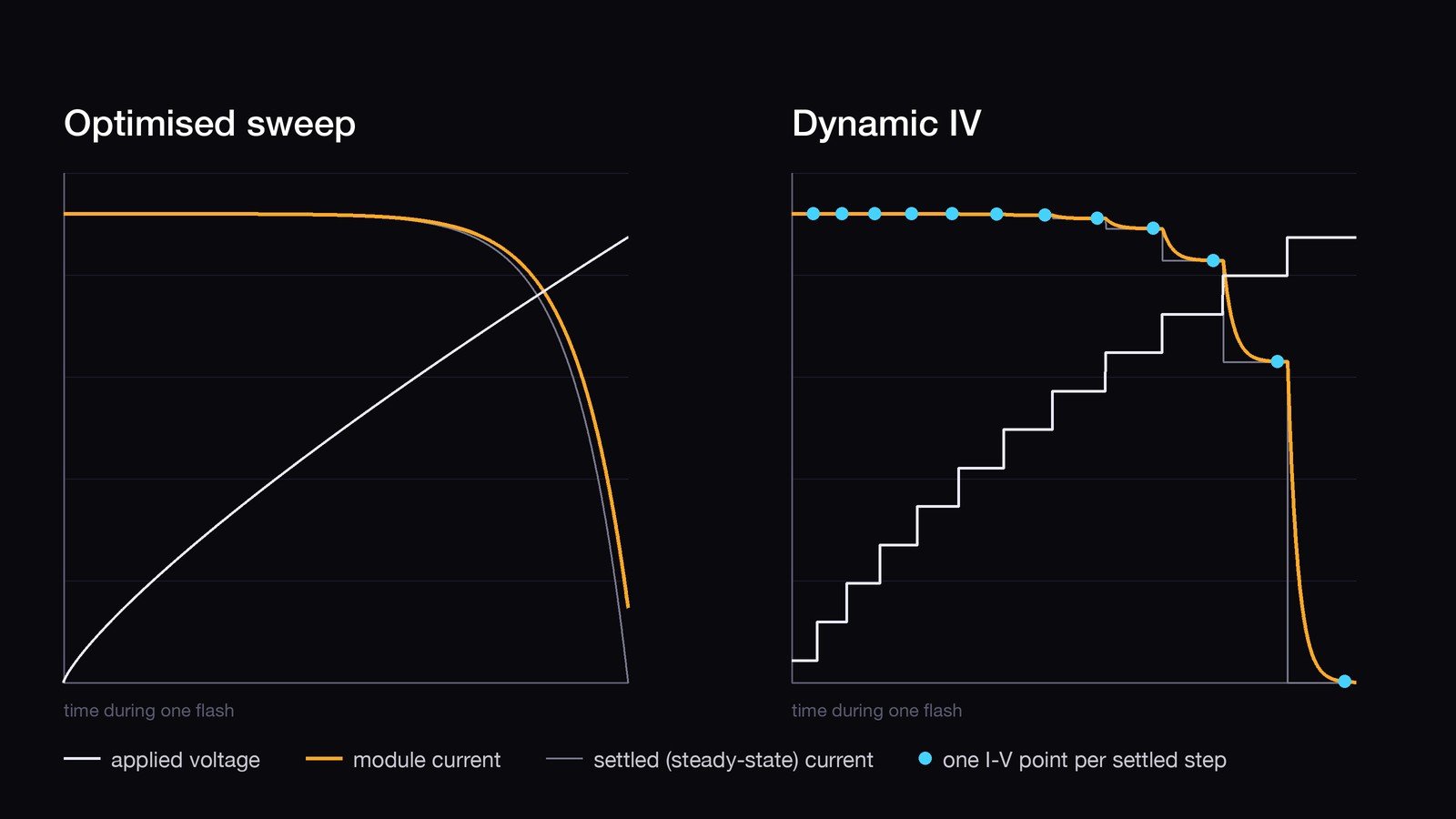
- Each step is held until the capacitive current has died away. Only the settled end of the step is kept: one clean I-V point per step.
- Steps are short where the curve barely moves, near Isc, and longer toward Voc, where the module's capacitance is largest.
- The whole curve is taken in one flash, so the method keeps the throughput of a production line.
The picture at the top is a schematic, not a measurement. Left, an optimised continuous sweep: the voltage never stops, so the current never reaches its settled value. Right, Dynamic IV: each step is held until the current has settled, and one point is taken from the settled end.
On Avalon Nexun systems the method is called Dynamic IV, and on Pasan xenon systems DragonBack®: the same algorithm, in the same PVStudio software. On a Nexun PRO MAX or Nexun ULTRA the long LED pulse leaves room for long settling steps, and the time-resolved samples of every flash are kept with the measurement so the steps can be checked.
An optimised sweep is not Dynamic IV
The name is now used loosely. Some instruments are offered as “dynamic IV” although what they do is an optimised continuous sweep: the ramp is slowed down, reshaped, or run in both directions and averaged. These measures reduce the transient error, and they can be worth having. But the voltage never stops, so no point of the curve is ever measured with the module settled, and what remains of the error depends on the module and is not measured. That is a different method with a different uncertainty, and it should carry a different name.
The difference does not show on a datasheet, where both are one line. It shows in the raw data of a flash, which is why the questions below ask for data rather than descriptions.
Five questions to ask any supplier
- Does the applied voltage stop at each point of the curve, or does it keep moving? Ask for a plot of voltage and current against time during one flash, on your module.
- How is each I-V point formed: from the settled end of a step, or from samples taken while the voltage is moving?
- How is settling decided: from the behaviour of the module under test, or from a fixed setting that is the same for every module?
- Do the forward and the reverse sweep give the same maximum power on your most capacitive module, in one flash each?
- Against which reference was the method validated (steady-state or multi-flash), on which modules, and with what deviation? Ask for the answer in writing.
A real Dynamic IV answers all five with data. If the answer is a slower or smoothed sweep, it is an optimised IV: useful, but not the same measurement. Put the answer in the purchase order, together with the validation figure.
Measure your own module
The surest check is your most capacitive module on the system you are considering, with the raw samples of the flash in hand. Send us a module or ask for a measurement, and read what makes a solar simulator right for TOPCon.