
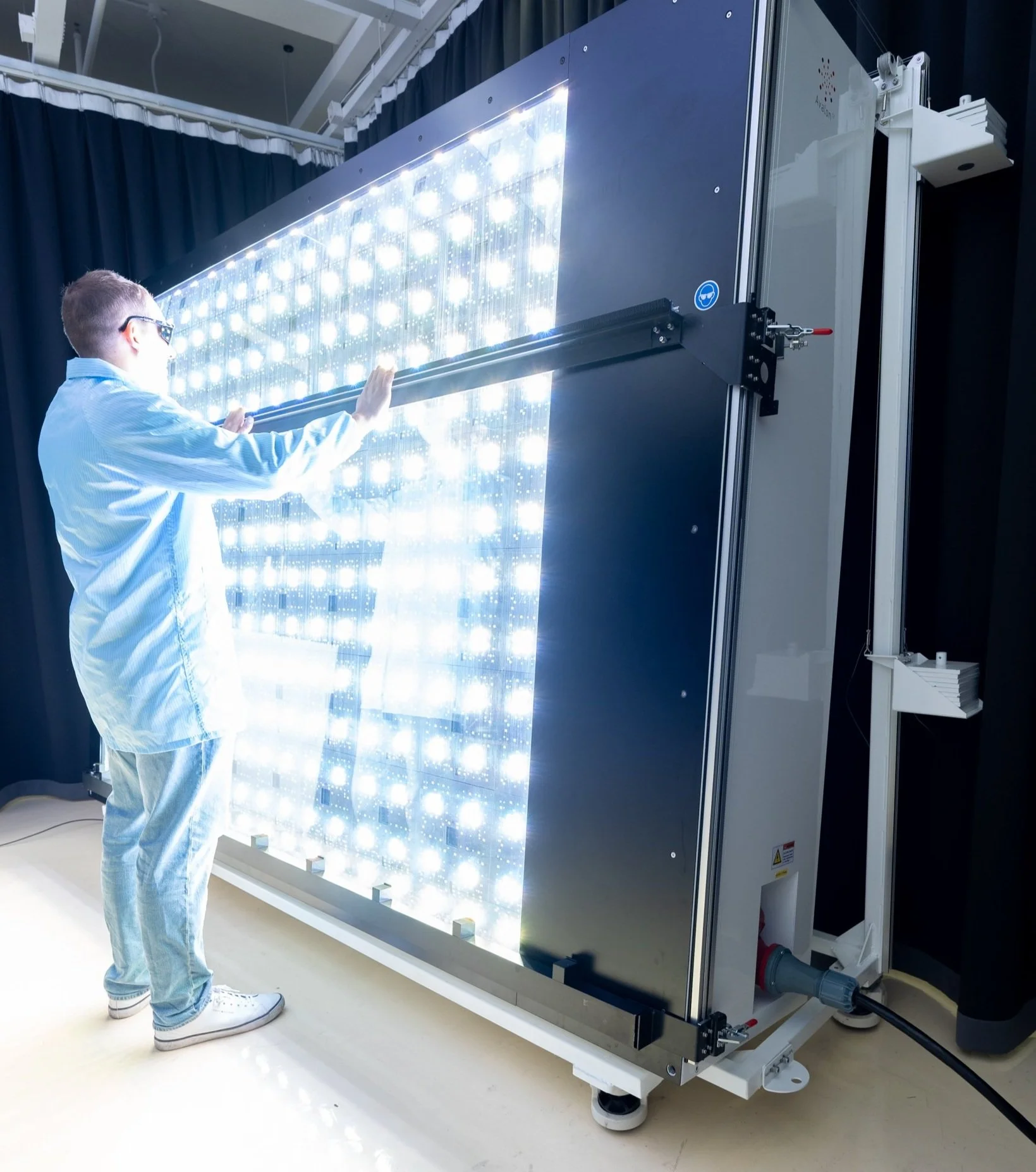
Nexun Steady

100% LED. Steady-state.

A pure-LED steady-state simulator. Reduced 300–1000 nm spectrum for perovskite work, or full 300–1200 nm for silicon. No hybrid, no halogen, no consumables. Stability better than 0.5% over one hour, with an optional thermal-chamber companion sized for the heat load of continuous illumination.

100% LED · 300–1000 nm or 300–1200 nm · <0.5% / 1 h
Request a quote Get datasheet
100%
LED
no hybrid, no halogen
<0.5%
Stability
over 1 hour
300–1000
Perovskite spectrum
1200 nm option for c-Si
0
Consumables
full lifetime LED engine
Why pure LED

No hybrid. No halogen. No consumables.

Other steady-state simulators reach for a tungsten-halogen or xenon arc bolt-on the moment the spectrum gets demanding. That is where the consumables come from, the spectral drift, the lamp-replacement downtimes, the maintenance schedule. Nexun Steady is 100% LED. Every photon is generated by a solid-state engine that is rated for the lifetime of the simulator, so the spectrum does not drift between shifts and the only maintenance is the auto-cal cycle.

Spectrum

Different cells. Different bandgap.

Steady is configurable to the spectral range your devices actually respond to. Pick the perovskite-optimised 300–1000 nm spectrum, or extend to the full 300–1200 nm silicon range. The IR you don't need is the IR you don't pay for, in capex or in cell heat.

Perovskite spectrum

300 – 1000 nm

Perovskites are insensitive beyond 1000 nm. Generating IR you cannot use is electricity wasted as heat directly into the device under test, which makes the measurement harder and the cell hotter for no reason. The 300–1000 nm reduced spectrum drops the IR you don't need, lowers the heat load on the cell, and keeps the build cost of the simulator down.

Lower costLess heatNo wasted IR
Silicon spectrum

300 – 1200 nm

Specify the 1200 nm extension and Steady covers the full crystalline-silicon response, including the deep-red and near-IR contribution that determines accurate Isc on c-Si. Same engine, same software, same stability budget, just the wavelengths added back in.

Full c-Si coverageSame engineOptional
What it runs

Tests where a flash is the wrong tool.

Some measurements need a flash. Steady is for everything else, the standards and characterisations that demand continuous illumination, with the spectral and temporal stability to survive a long soak.

  1. 01

    Perovskite preconditioning

    Bring perovskite devices to their stabilised operating point under realistic illumination before the IV measurement. Steady-state output, the right spectral coverage, no metastability artefacts in the result.

  2. 02

    Hotspot and IEC standard tests

    Hotspot, partial-shading, reverse-bias and similar IEC tests require a continuous light source, not a flash. Nexun Steady is built to sit under those tests for the durations the standard demands without drifting.

  3. 03

    Temperature coefficient & low-irradiance

    Sweep cell or module temperature under stable illumination, or characterise low-light response down to the irradiances that matter for real deployment. Stability < 0.5% over 1 hour means the data you collect over a long sweep is the data you intended to collect.

  4. 04

    MPP-tracker validation

    Validate inverter MPP-tracking algorithms against a known, repeatable, programmable steady-state input. Drive irradiance steps, holds, transients, then read what the tracker did against ground truth.

Optional companion

Stays on temperature, even under continuous light.

Continuous illumination heats the device under test. A standard temperature chamber cannot keep up with the energy that a steady-state simulator dumps into a module over a long soak, the temperature drifts, and the test data drifts with it. The Avalon thermal-chamber companion is sized specifically for the steady-state heat load: more cooling capacity, more headroom, the device stays on its setpoint through a full IEC hotspot or preconditioning cycle.

Designed for Steady

Thermal chamber

Higher-capacity HVAC, four-zone PID, panel uniformity better than ±1.7 °C. Anti-reflection substrate facing the simulator.

Why oversize

Steady-state delivers more total energy into the module than any pulsed test, so the chamber is sized for that load specifically, no thermal drift over a multi-hour soak.

Who it's for

For the lab that lives between flashes.

Steady is the right answer when the test takes seconds to minutes to hours, not milliseconds; when standards demand continuous light; when perovskite needs preconditioning; when the question is not "what does this module do at one moment" but "what does this module do under realistic, sustained light".

  • Perovskite labs preconditioning before IV
  • Module testing under hotspot, partial-shading and reverse-bias standards
  • Temperature-coefficient and low-irradiance characterisation
  • MPP-tracker validation against a known steady reference
Specifications

Every number, on the table.

Active-area variants, irradiance trim, the 1200 nm extension and the thermal-chamber companion are detailed in the full datasheet. Request access below.

Light source100% LED, steady-state, no hybrid, no halogen
Spectrum (perovskite)300 – 1000 nm
Spectrum (silicon)300 – 1200 nm (optional extension)
ModeContinuous (steady-state)
Irradiance range100 – 1200 W/m²
Stability< 0.5% over 1 hour
Non-uniformity< 2% (A+)
IEC 60904-9 classA+ A A+
Standards / testsIEC hotspot, partial shading, reverse bias, preconditioning, temperature coefficient, low-light, MPP
ConsumablesNone
Optional companionThermal chamber sized for steady-state heat load
ComplianceIEC 60904-9 ed.2 & ed.3
Request full datasheet
Talk to an engineer

Tell us your samples. We’ll size the bench.

Perovskite, silicon, hotspot, MPP, share what you need to measure and our application engineers will reply within a working day with a configuration.