One wavelength at a time
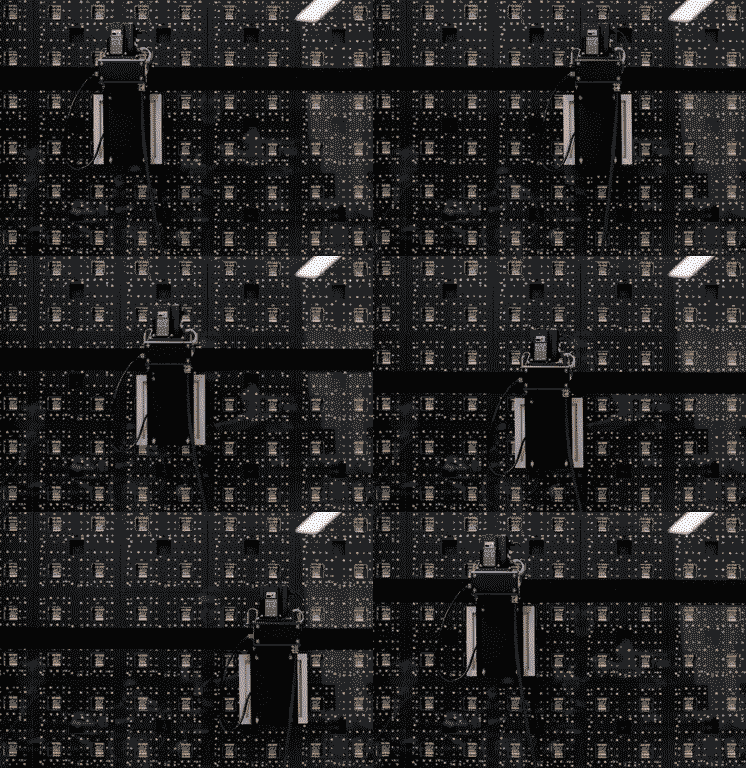
Drive a single LED band, measure the cell, move on. The simulator does the sweep, the software does the bookkeeping.
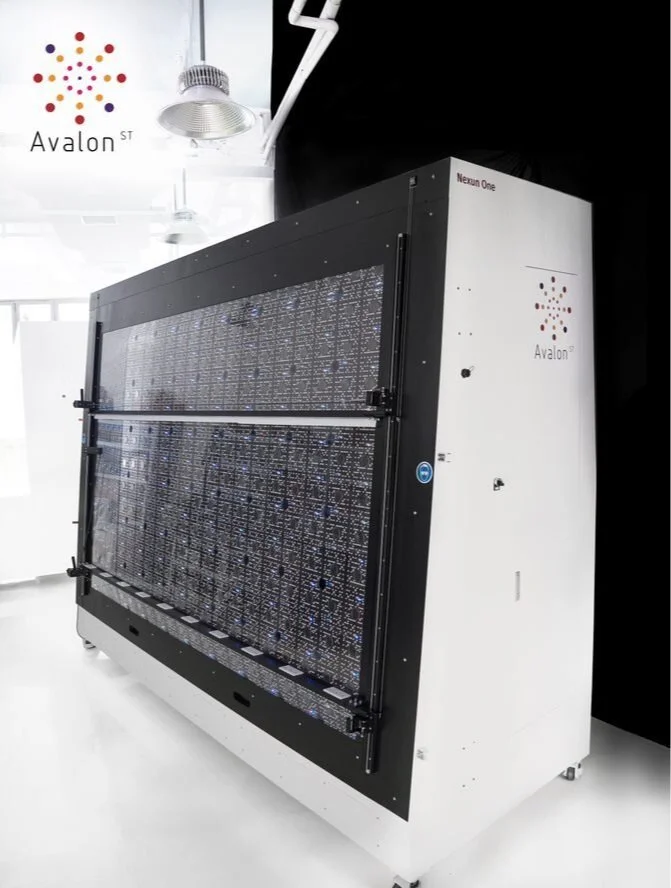
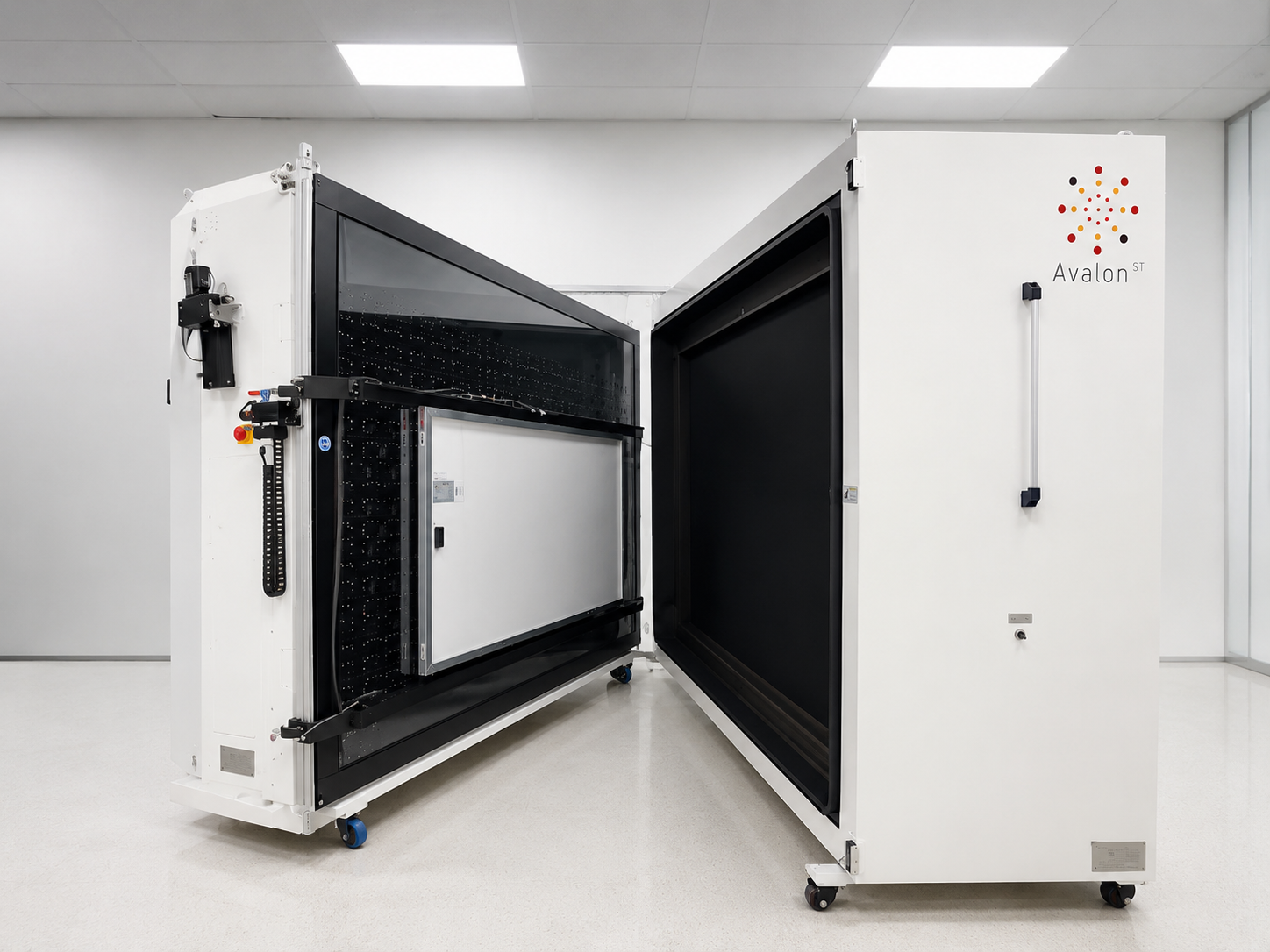
The reference instrument of the Nexun line, and the most capable LED solar simulator on the market. 37 wavelengths driven by 32 independent control channels, individually addressable in software. Integrated SPD below 20%, beating typical xenon. A+++ A++ A+++ per IEC 60904-9, with optional EL on the same bench. When the number has to survive an audit, it is measured on ULTRA.
ULTRA is not the cheapest Avalon. It is the most accurate, the most controllable and the most flexible, and that is the trade-off it asks you to accept. If your measurement uncertainty defines someone else’s product spec, this is the instrument the rest of the catalogue is calibrated against.
Every Nexun shares the same physics-grade engine. ULTRA adds four capabilities the rest of the line cannot reach without changing hardware.
Pro and Pro Max use 8 independent power channels to drive their 17 and 22 wavelength engines respectively. ULTRA quadruples that — 32 control channels driving 37 wavelengths — so each band has its own current loop. The simulator can hold a target spectrum tighter, reach SPD numbers Pro/Pro Max physically can't, and stay calibrated through current changes that would force lower-channel systems to recompensate elsewhere.
Any individual LED wavelength can be turned on or off from software. That single capability turns ULTRA from a measurement instrument into a spectral-response measurement instrument: drive one wavelength at a time, measure the cell's response, repeat across the band set, and you have a full spectral-response curve without a separate monochromator bench.
Xenon-flash simulators typically integrate to ~25–30% spectral deviation against AM1.5G. ULTRA's 32-channel, 37-wavelength engine integrates to under 20%. That is below the typical xenon floor on the same metric — without bulb decay, without spectral drift between flashes, without consumables. The reference instrument that doesn't need a reference instrument.
ULTRA can be ordered with an integrated electroluminescence imaging path. IV under the same illumination, EL on the same module, on the same calibration chain, in the same software. For labs that publish, that is one less instrument to characterise and one less bench-to-bench transfer error in the dataset.
All three Nexuns share the same software stack and the same calibration chain. The physical engine is where they diverge. Pro and Pro Max are tuned for the cost-per-flash sweet spot in production and quality-lab work; ULTRA is engineered for the measurement uncertainty that everything else gets compared against.
4× more independent channels. Every band can be set, swept and verified on its own.
Ten extra wavelengths give a smoother, denser spectrum across the IEC bands, especially in the IR tail.
Below the typical xenon floor on the same integrated SPD metric, without bulb decay or consumables.
| ULTRA | Pro Max | Pro | |
|---|---|---|---|
| Control channels | 32 | 8 | 8 |
| Wavelengths | 37 | 22 | 17 |
| Per-wavelength on / off | Yes | — | — |
| Spectral response measurement | Built-in | — | — |
| Spectral match per band | < 1% | A+ | A+ |
| Integrated SPD | < 20% | 27% | 35% |
| LTI over pulse | 0.2% | 0.2% | 0.3% |
| Non-uniformity | < 0.5% | < 1% | < 1% |
| IEC 60904-9 class | A+++ A++ A+++ | A++ A+ A++ | A++ A+ A++ |
| Optional EL | Yes | — | — |
Spectral response (also called external quantum efficiency) is normally a separate instrument: a monochromator scanning the spectrum, a chopper, a lock-in amplifier, its own calibration chain. ULTRA collapses that into the simulator itself by addressing each LED wavelength independently in software, so the cell’s response can be characterised band by band on the same bench, in the same software, against the same reference.
Drive a single LED band, measure the cell, move on. The simulator does the sweep, the software does the bookkeeping.
No second instrument to qualify. Spectral-response data is on the same traceability chain as the IV measurement next to it.
One instrument, one operator, one log file. Fewer transfer errors, faster iteration on tandems and emerging chemistries.
ULTRA can be ordered with an integrated electroluminescence imaging path. IV under the same illumination, EL on the same module, on the same calibration chain, in the same software. For labs that publish, that is one less instrument to characterise and one less bench-to-bench transfer error in the dataset.
A CMOS array captures the full module in a single sweep, resolving microcracks, finger interruptions, dead cells and series mismatch.
Our stitching pipeline delivers a clean composite in seconds, no operator intervention. Click the image to view the full-resolution capture.
EL and IV share the same traceability and the same software. No second instrument to qualify, no transfer step between benches.
ULTRA shares the modular Nexun architecture. Add temperature-coefficient capability or extend the reference-cell set when the measurement calls for it. Every add-on runs through the same operator console and the same calibration chain.
ULTRA is the right answer when the measurement uncertainty matters more than the cycle time, when the dataset has to survive an audit, when the question isn’t “is this good enough for production” but “what is the best number physics will give us”.
Active-area variants, EL configurations and per-junction reference cells are detailed in the full datasheet. Request access below.
Cell chemistry, target uncertainty, optional EL, share what you need to measure and our application engineers will reply within a working day with a configuration.