
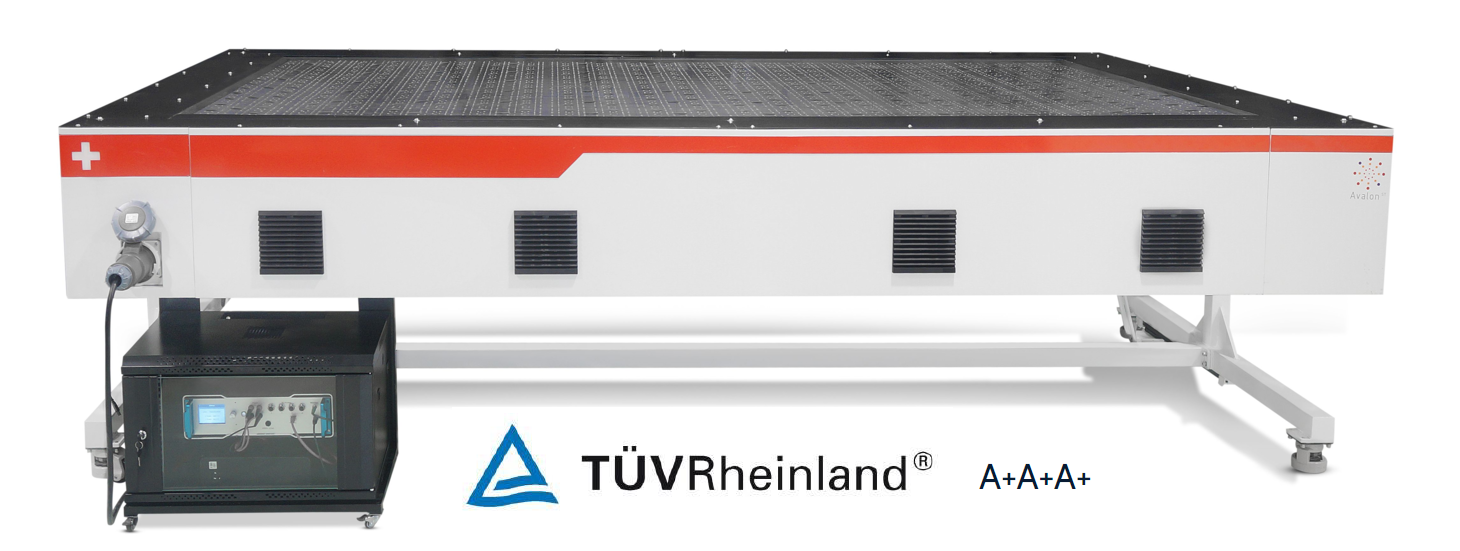
Certification-grade silicon. At lab-standard cost.
The silicon workhorse of the industry. Seventeen wavelengths, eight control channels, full 1.8 by 3 m active area and a 500 ms long pulse that handles HJT-class capacitance without 60 flashes per module. The Nexun the University of New South Wales chose, and the one labs and module makers default to.
The Nexun for everyone who measures silicon.
ULTRA is the reference instrument and Pro Max adds perovskite, CIGS and thin-film to the recipe. Pro stays focused: certification-grade IV on the silicon chemistries that account for almost everything actually installed today, in a package tuned for the cost-per-flash sweet spot. It is the Nexun a lab buys when it needs A-class numbers without paying for capabilities it will not use.
Four reasons labs default to Pro.
Same calibration chain as ULTRA. Same physics-grade engine architecture. Tuned for the chemistries that drive volume PV and the throughput a working lab actually needs.
- 01
Built for silicon, all of it.
Pro is engineered for the chemistries that account for ~99% of installed PV: c-Si, PERC, TOPCon and HJT. Seventeen wavelengths over 300 to 1200 nm, eight independent control channels, and a spectrum tuned to the metrics that matter for crystalline silicon module measurement. No compromise on the cells you actually ship.
- 02
Certification-grade by default.
A++ on spectral match, A+ on non-uniformity (<1%), A++ on temporal stability per IEC 60904-9 ed.2 & ed.3. Pro hits A-class on every dimension that drives laboratory uncertainty, with the headroom to stay there as the LED engine ages. The instrument you put on a quote when the customer asks for IEC compliance.
- 03
Long pulse where it matters.
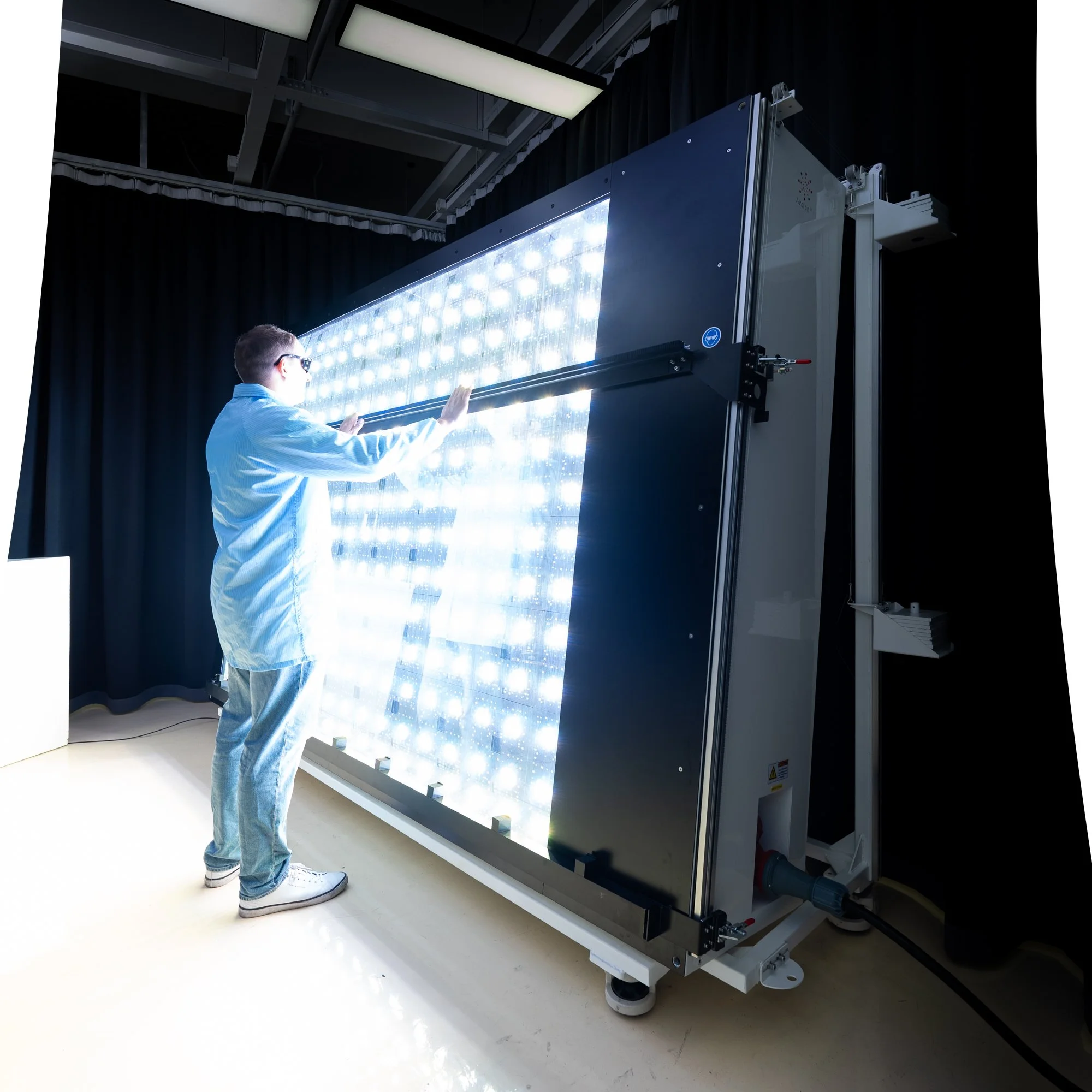
A 500 ms measurement pulse is long enough to settle the capacitive response of modern HJT modules without forcing the 20 to 60 flashes other simulators need to reconcile forward and reverse sweeps. One flash, both sweeps in agreement, no thermal drift. The IV curve lands clean.
- 04
Same software as ULTRA.
Pro shares the software stack, the calibration chain and the data formats with the rest of the Nexun line. Numbers measured on Pro map cleanly onto ULTRA and Pro Max. Your reference benchmarks travel between instruments. Your operators learn one interface, not three.
A Nexun PRO ships to UNSW Sydney.
The University of New South Wales is the institute behind the modern PERC cell and several world-record silicon efficiencies. When their measurement bench needed an LED-class upgrade for next-generation cells, they chose Nexun PRO. Cleaner spectra, longer pulses, sharper data on the chemistries they ship.
Read the article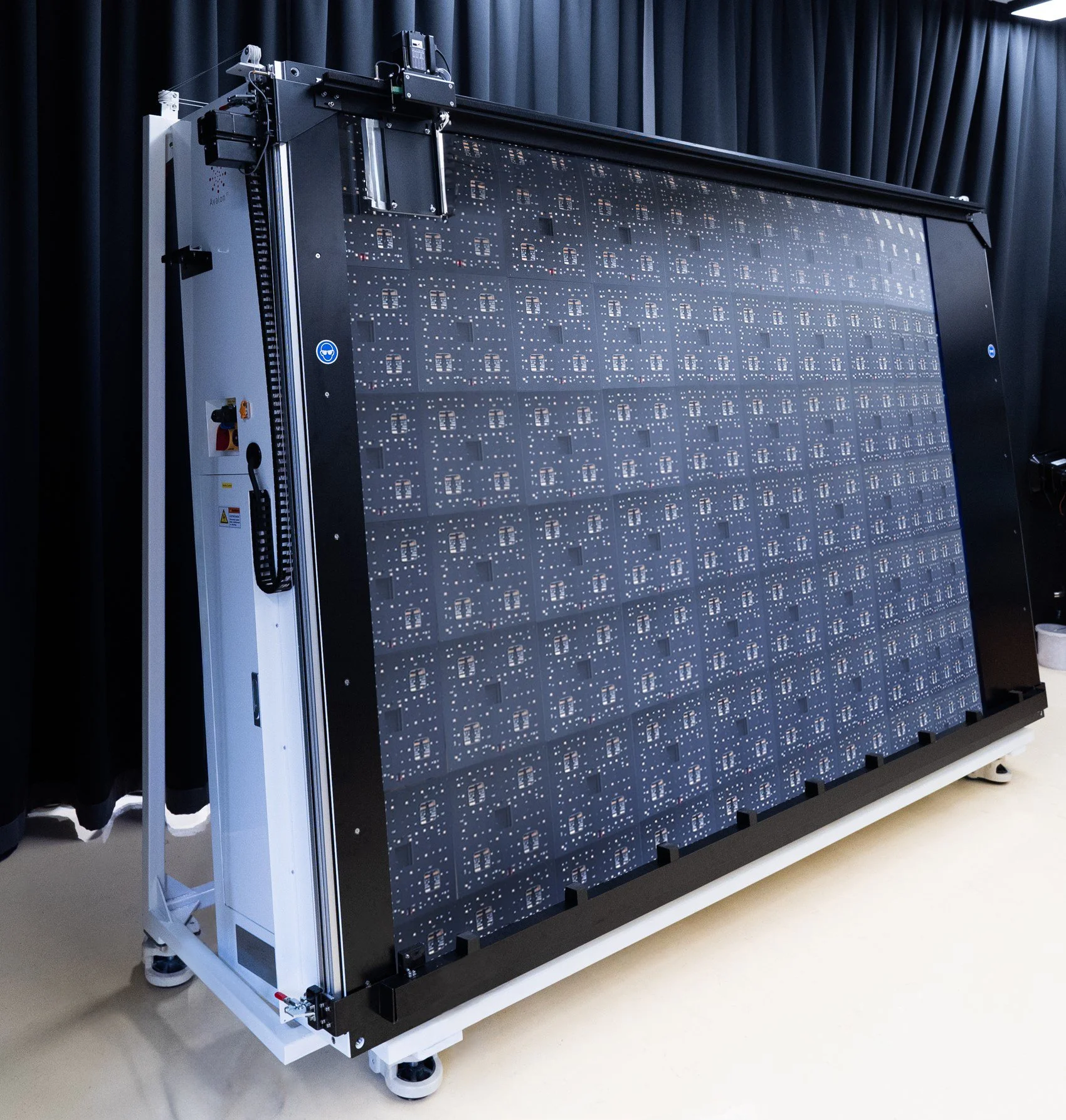
Configure it to your bench.
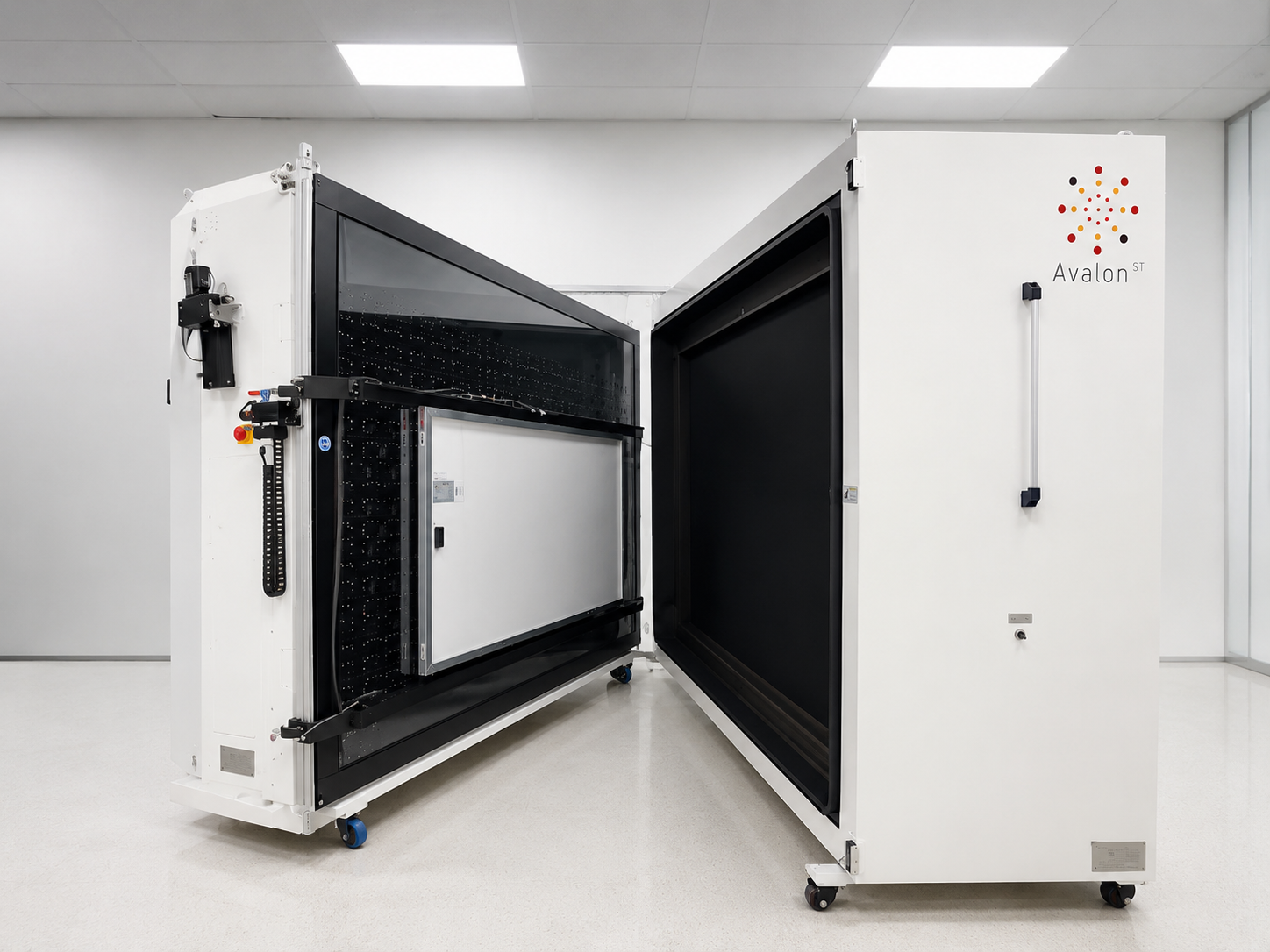
Pro is built around a modular Nexun architecture. Add temperature control, electroluminescence imaging or steady-state preconditioning when the application asks for it. Every add-on runs through the same operator console and the same calibration chain.
Picking the right Nexun.
All three share the same software, the same calibration chain and the same overall architecture. The differences are in the engine. Pro is the silicon specialist; Pro Max widens the chemistry envelope and lifts SPD; ULTRA is the reference at the top of the line.
| Pro | Pro Max | ULTRA | |
|---|---|---|---|
| Wavelengths | 17 | 22 | 37 |
| Control channels | 8 | 8 | 32 |
| Active area | 1.8 × 3 m | up to 1.8 × 3 m | 1.8 × 3 m |
| Irradiance | 1100 W/m² | 1300 W/m² | 1100 W/m² |
| Integrated SPD | 35% | 27% | < 20% |
| LTI over pulse | 0.3% | 0.2% | 0.2% |
| Non-uniformity | < 1% | < 1% | < 0.5% |
| IEC 60904-9 class | A++ A+ A++ | A++ A+ A++ | A+++ A++ A+++ |
| Chemistries | Si, PERC, TOPCon, HJT | + perovskite, CIGS, thin-film | All, plus per-wavelength |
| Per-wavelength on/off | — | — | Yes |
For the labs and lines that ship silicon.
Pro is the right answer when the bench has to deliver A-class IV on c-Si modules every working day, when the budget is real, and when perovskite or thin-film are not on the roadmap. If they are, you want Pro Max.
- ►Cell and module manufacturers needing certification-grade IV at production rhythm
- ►University and research labs working c-Si, PERC, TOPCon and HJT
- ►Pilot lines and quality-assurance labs in module factories
- ►Reference labs that need IEC 60904-9 A-class without ULTRA's spectral-response capability
Every number, on the table.
Active-area variants, optional EL configuration and reference cell sets are detailed in the full datasheet. Request access below.
Tell us your modules. We’ll size the bench.
Cell type, module dimensions, throughput target, certification scope. Our engineers come back with a configured Pro and a number on it, usually in 48 hours.