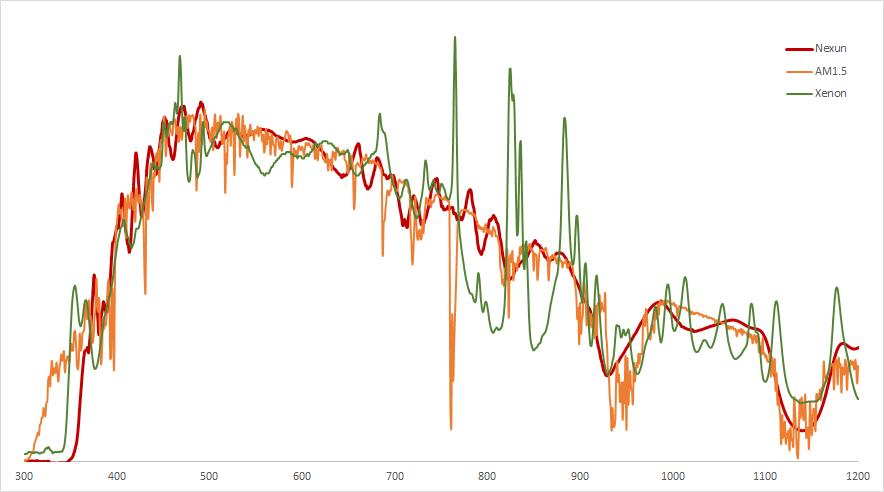
During my time at TÜV Rheinland, my first task was to improve measurement accuracy, and in particular repeatability over the long term, on the order of a year or more. That work led me to learn something often ignored, but by far the biggest single contributor to PV measurement uncertainty.
How uncertainty is usually estimated
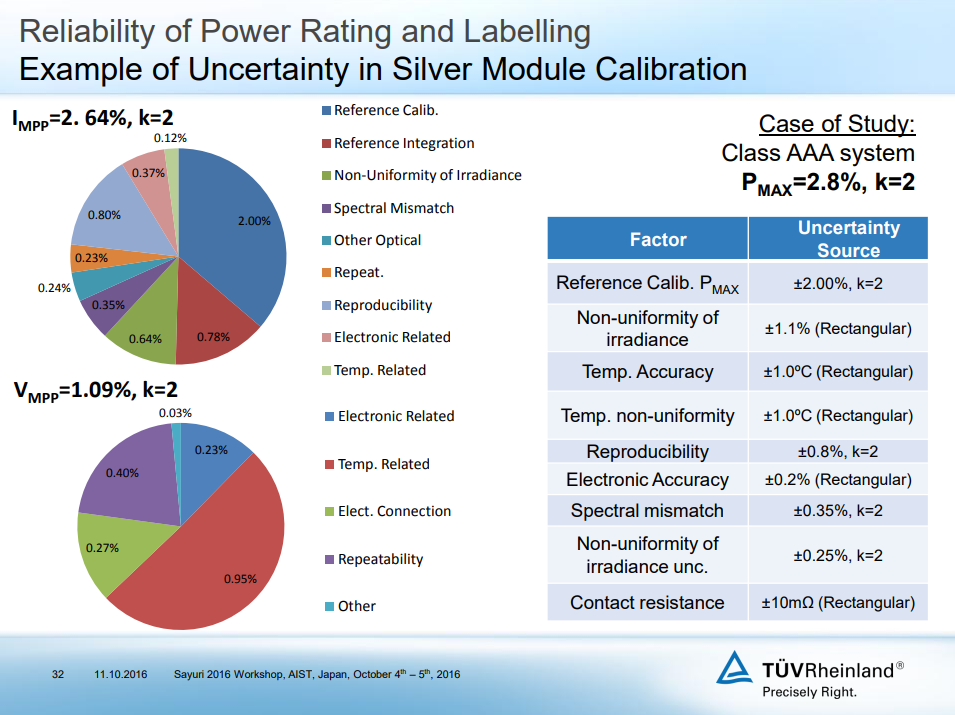
Uncertainty budgets are built by taking each element of the measurement chain, estimating how each can drift or be perturbed, and adding the contributions in quadrature. Done properly, the analysis can get arbitrarily detailed, but in a typical lab setup the main contributors are absolute irradiance, spatial non-uniformity, spectral mismatch, thermal stability, and human error.
The biggest contributor is human error
Of those five, human error is by far the largest, and the hardest to predict or trace. Imagine an operator measuring tens of modules a day, all of different sizes and properties. A misaligned reference cell, a misplaced temperature probe, a wrong software parameter, and the result drifts by a few percent without anyone noticing.
There are two effective mitigations: automation and traceability.
Automation
Automation applies to the hardware setup as well as the software. Mounting the reference device on a sliding rail prevents misalignment when module thickness changes. Locking critical software parameters prevents accidental edits. Reducing the number of operator inputs to the bare minimum cuts the surface area where mistakes can land.
Traceability
Traceability is the cornerstone of long-term reliability. Every measurement, every set of parameters and every result has to be recorded, indexed and retrievable. Implementing this rigorously is harder than it sounds, it usually requires custom software, and not every lab has the resources. But continuous analysis of the measured population is the only reliable way to detect long-term drifts before they become a quality problem.
Daily and weekly checks, a stable reference module measured at a fixed schedule, are the simplest and most effective traceability tool. They catch everything from sensor drift to a stray patch of sunlight hitting the lab through a skylight that nobody had noticed for months.
The same reasoning ultimately drove the Nexun design philosophy: lock the operator out of the parameters that matter, automate alignment, log everything, and make traceability a feature of the instrument rather than a discipline asked of the engineer. Uncertainty drops because the failure mode that dominated the budget, the operator, has been engineered out of the loop.