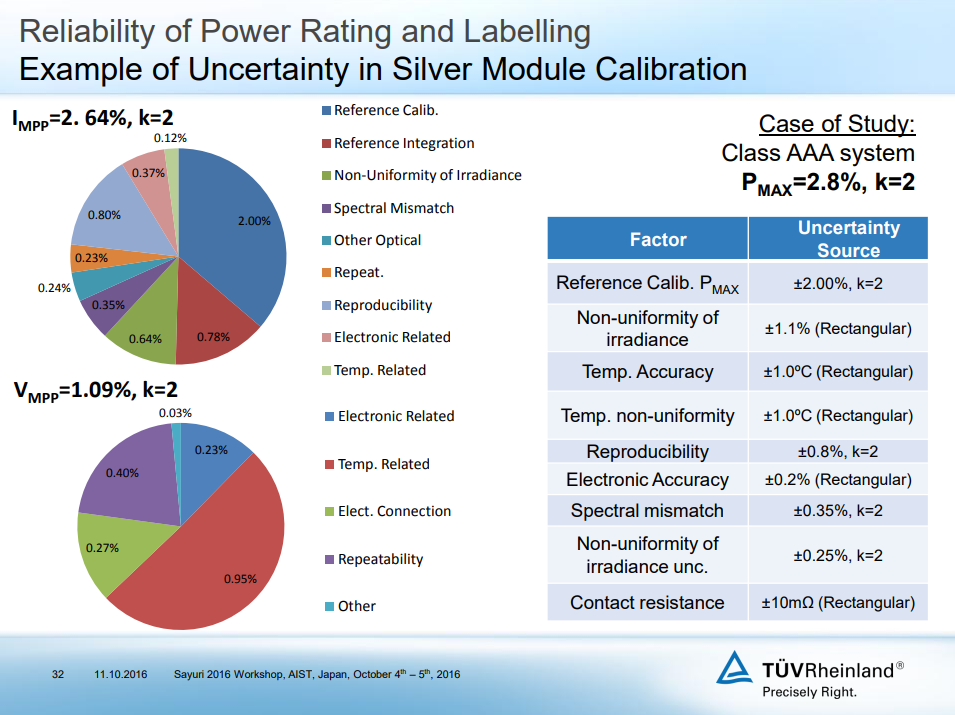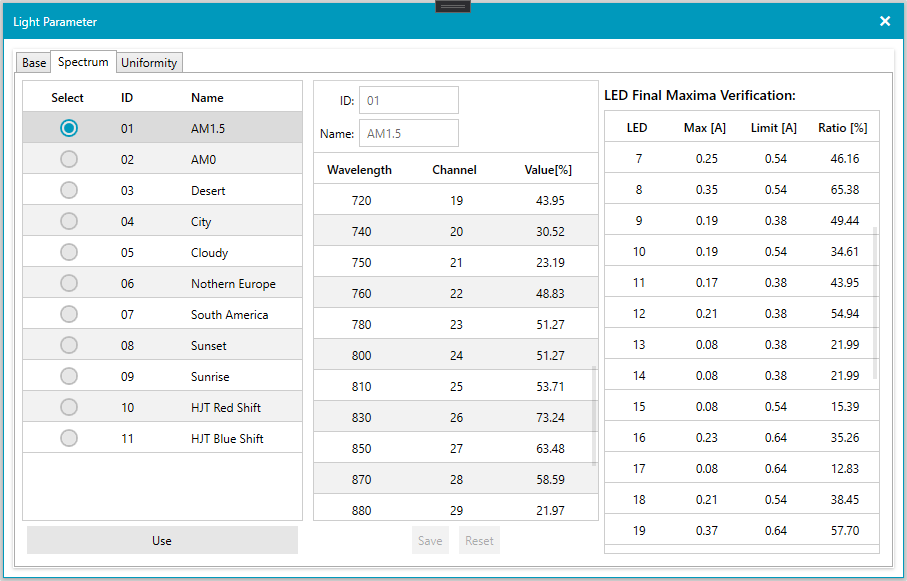
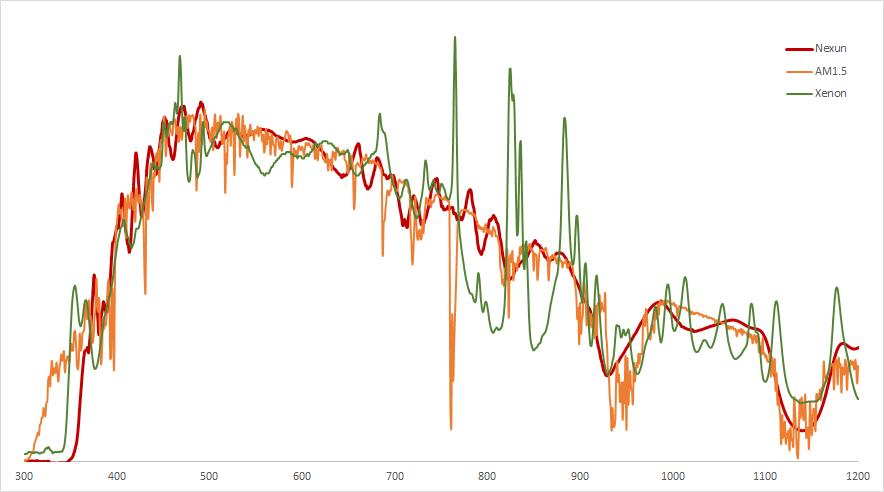
Avalon ST has achieved a continuous, xenon-like spectrum from 300 to 1200 nm using a patented LED architecture, on a large-area A+A+A+ solar simulator at a cost comparable to xenon-based systems. This is, to our knowledge, the first time the LED class has matched the xenon class on the spectral metric that actually drives PV measurement uncertainty.
Why most LED simulators have a spiky spectrum
Most LED solar simulators on the market combine 8 to 12 LED types. That is enough to pass the IEC 60904-9 binning class to A+, but the spectral match across the full AM1.5G distribution remains coarse. The result is a visibly spiky spectrum, with gaps the standard does not penalise but the cell sees. For modern cell architectures, those gaps translate into spectral mismatch that the calibration cannot fully cancel out.
There is a second issue, less talked about. Power LEDs above 1000 nm have historically been weak or unstable. Many LED simulators either skip the 1000 to 1200 nm band or run it at a level that degrades quickly, which is exactly the band where silicon's spectral response is highest and where infrared mismatch causes the most damage to the IV curve.
What we did differently
The Nexun simulator combines 31 LED types across 300 to 1000 nm with a patented stable source for 1000 to 1200 nm. The result is an adjustable, stable, continuous spectrum across the full silicon and tandem-relevant range, rivalling xenon in shape and beating it on stability and tunability.
Why this matters
LEDs come with advantages that xenon cannot deliver. Spectrum is adjustable channel by channel, pulse can be long or steady-state, output is stable over thousands of hours, and the energy footprint is a fraction of a xenon arc. For PERC, HJT and the rising tandem chemistries, those capabilities are not nice-to-have, they unlock measurements that pulsed xenon cannot reach. Once the spectrum problem is solved, the LED class is the better choice for every metric that matters in PV measurement.