
01
Path generation
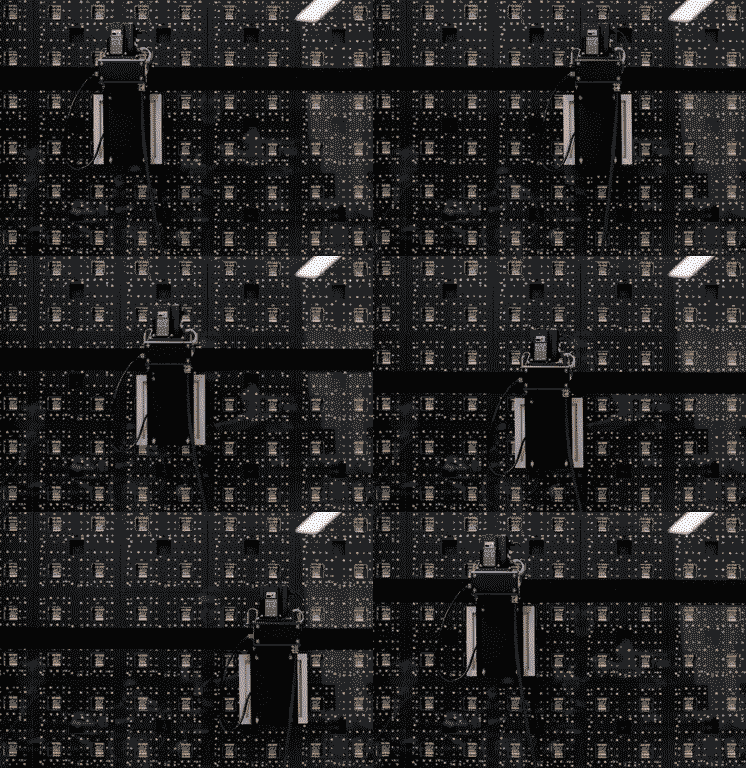
The software lays out a serpentine path across the active area and the robot drives a calibrated reference cell from cell to cell. The path covers every position required by IEC 60904-9 plus user-defined densification zones.
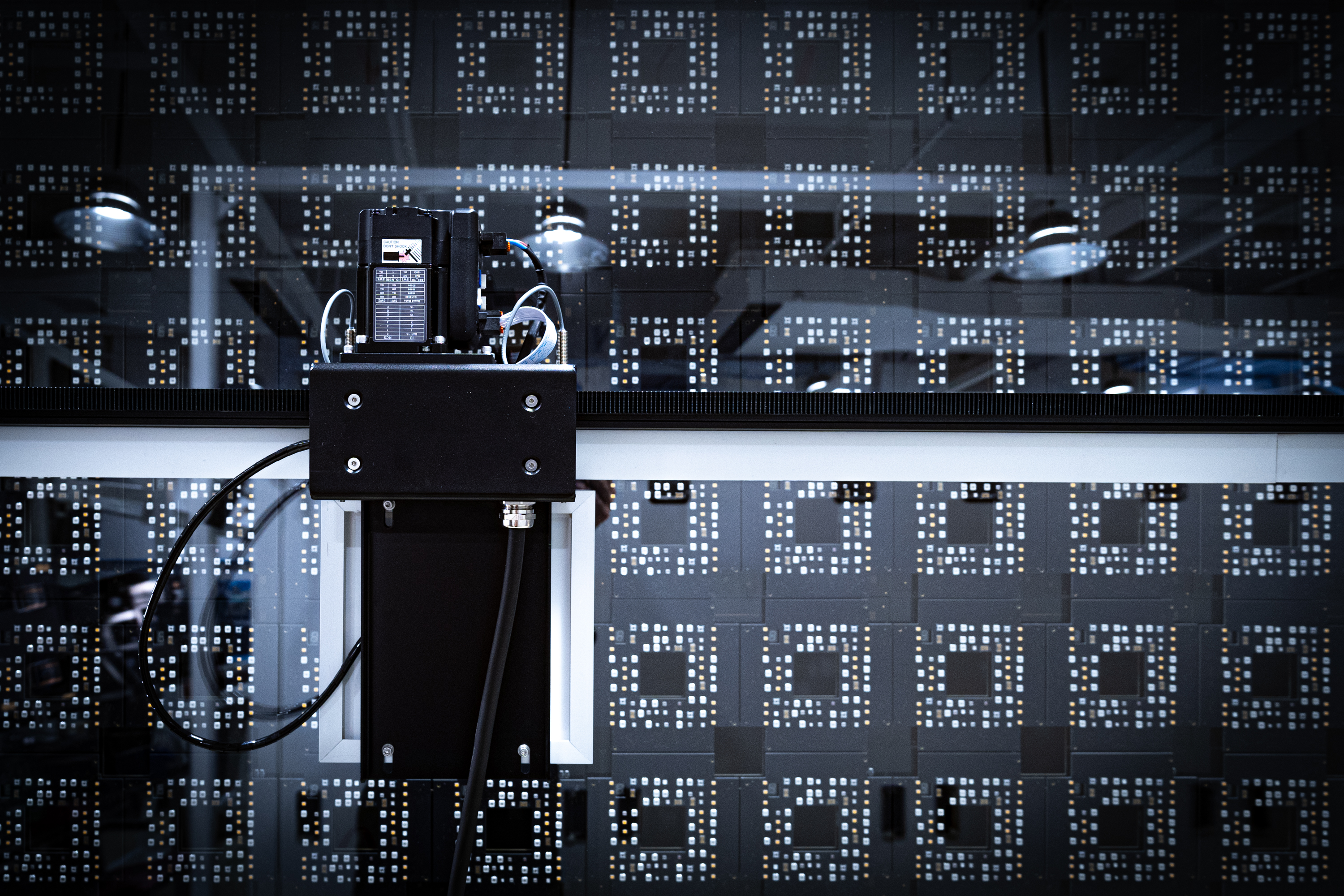
Spatial non-uniformity is the largest uncertainty contributor in IV measurement, and the one most labs stop tracking after installation. The Avalon Uniformity Robot maps the full active area in roughly five minutes, computes the corrections and writes them back into the simulator. Available on every Nexun and Pasan bench.
A calibrated reference cell rides a programmable path across the full active area. Each waypoint is sampled with the same calibration chain used for IV measurement. The full map is assembled in about five minutes, then the per-channel corrections are pushed back into the simulator without operator intervention.
Uniformity is the uncertainty contributor that quietly grows between certifications. The robot turns a half-day project into a five-minute routine, so the check actually happens.
Non-uniformity across the active area is the single largest uncertainty contributor in module IV measurement after spectrum, ahead of temperature and reference-cell drift. Yet most labs measure it once at installation, then never again — because a manual mapping takes hours of operator time on a bench that should be producing data.
LED engines age. Optics shift. Cover glasses pick up dust films. Without a routine uniformity check the drift goes invisible, so the lab keeps quoting an A+ class number long after the bench has dropped into A territory. Customers receive certificates the bench can no longer back up — a reputational problem the next round-robin will surface.
The robot drives a calibrated reference cell across the entire active area on a programmable path, samples the irradiance at every position, and assembles the uniformity map automatically. A full mapping completes in about five minutes, so a daily or weekly uniformity check stops being a project and becomes part of the warm-up routine.
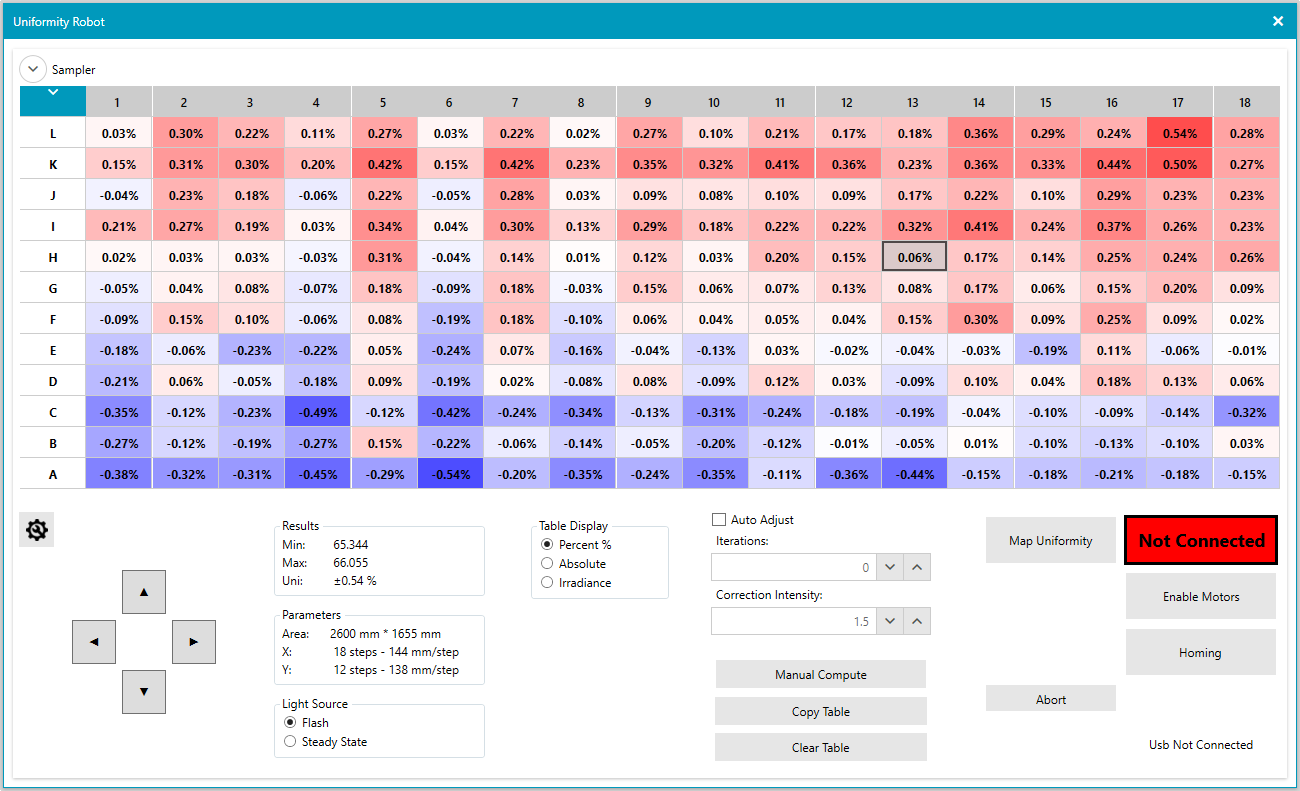
Once the map is acquired, the system computes the per-channel corrections that flatten the field and pushes them back into the simulator's calibration table. No spreadsheet, no manual transfer step, no second instrument. The bench self-adjusts and the next measurement runs on the corrected field.
The uniformity view lives inside the standard Nexun software. Operators kick off a scan, watch the map fill in live, then accept or roll back the correction. Every run is archived so drift trends are visible at a glance.
The full workflow is automated from the start button. Operators don’t move the probe, don’t copy numbers between programs and don’t hand-edit calibration tables.
The software lays out a serpentine path across the active area and the robot drives a calibrated reference cell from cell to cell. The path covers every position required by IEC 60904-9 plus user-defined densification zones.
At each waypoint, irradiance is sampled with the same calibration chain used for IV measurement. The full active area is mapped in roughly five minutes — hundreds of points, no operator intervention after the start button.
The map is fed into the per-channel solver. Corrections are computed for the LED engine and written back into the simulator's calibration table. The next IV measurement runs on the corrected field.
Every scan, every map and every correction is logged with timestamps and operator credentials. Quality teams see uniformity drift over time in the same database as their measurement history.
The robot is engineered as a universal accessory across the Avalon and Pasan lines. If the bench has an active area, the robot can map it — including instruments already in customer labs.
Native integration with the Nexun software stack. Per-channel correction writes directly into the simulator's calibration table.
Available as an option on every Pasan bench, including retrofits to instruments already on the floor.
Works with both pulsed and steady-state engines. The reference-cell timing is configured per bench type at commissioning.
Path planning scales from 156 × 156 mm cell stages to 1.8 × 3 m module fields without hardware changes.
Tell us which simulator is on your floor — new Nexun, installed Pasan, mixed fleet — and our engineers come back with a robot configuration and a retrofit timeline.