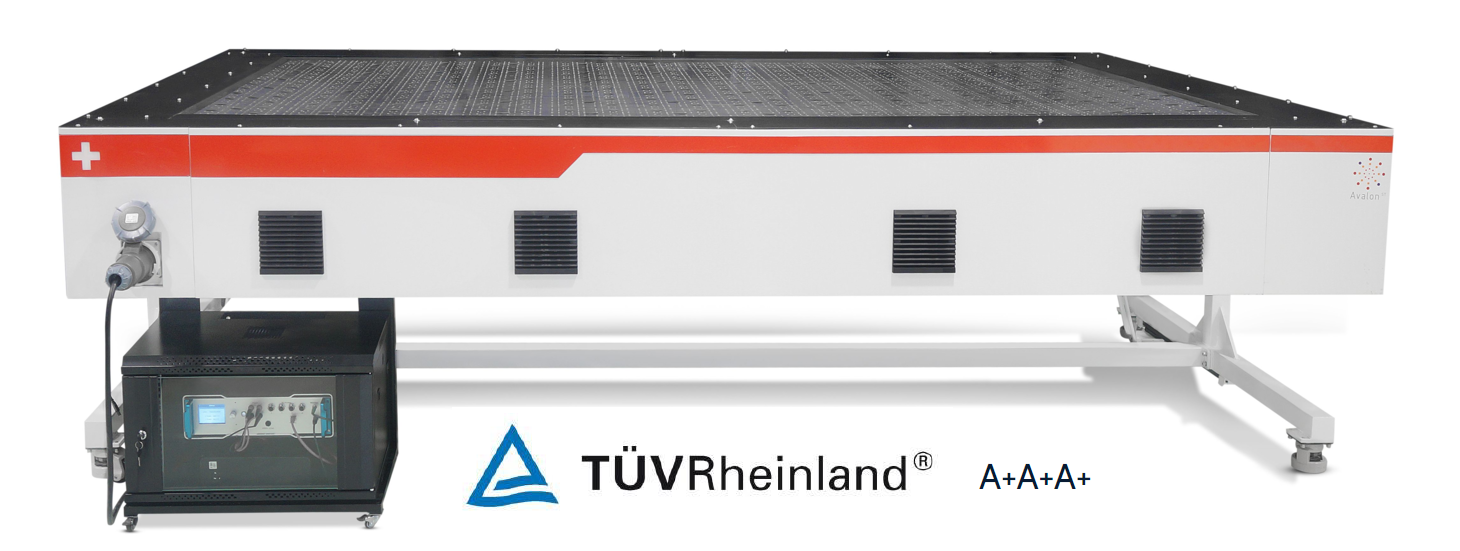
An LED solar simulator is bought on numbers, not adjectives. Five of them decide whether the instrument can carry the measurements your lab or line depends on: the IEC 60904-9 class, the measurement pulse length, the integrated spectral deviation against AM1.5G, the active area, and the guaranteed lifetime of the light engine. Everything else is configuration.
1. The IEC 60904-9 class
IEC 60904-9 grades a simulator on three independent properties: spectral match, spatial non-uniformity and temporal instability, reported in that order. A label like A+++ A++ A+++ is three grades, not one. The published top tier of the 2020 edition is A+; the industry uses A++ and A+++ as shorthand for performance two and four times tighter than the Class A limit. The Nexun ULTRA holds A+++ A++ A+++, the top of the scale, and is certified against both edition 2 and edition 3 of the standard.
2. Pulse length
Modern high-efficiency cells (HJT, TOPCon, perovskite tandems) are highly capacitive: a short flash sweeps the I-V curve faster than the cell can respond, and the measured power is wrong. A 500 ms long pulse measures the full curve in a single sweep, with no transient error and no multi-flash reconstruction. Every long-pulse Nexun, from PRO to ULTRA, measures 500 ms natively.
3. Spectral deviation (SPD)
Class tells you the spectrum fits inside per-band windows; integrated SPD tells you how far the whole spectrum sits from AM1.5G. Lower SPD means smaller spectral-mismatch corrections and lower measurement uncertainty. The Nexun ULTRA holds integrated SPD below 20%, better than a typical xenon flasher, with 37 wavelengths that can be switched per-band in software for spectral-response measurement.
4. Active area
The simulator must cover the largest device you will ever certify, at full uniformity. The Nexun line spans 600 by 600 mm research benches (MiniLab) to production and laboratory systems at 1.8 by 3 m and beyond, each scanned by a TÜV-verified uniformity robot at every cell position.
5. Lifetime and cost of ownership
Xenon lamps age, drift and get replaced; LED engines do not. Every Nexun light engine is guaranteed for 3,000,000 flashes with no consumables and no spectral drift, which is what makes the cost-per-measurement of LED simulators decisively lower over a production line's life.
Which Nexun, in one line each
- Nexun ULTRA: the reference instrument, for labs whose numbers must survive an audit.
- Nexun PRO MAX: the new benchmark for quality labs, silicon to thin-film on one bench.
- Nexun PRO: the industry's default silicon workhorse, certification-grade at production cost.
- Nexun EVO: production-line throughput at full takt.
- Nexun Mobile Lab: the accredited-grade flash lab that drives to the plant.
Frequently asked questions
- What is the best LED solar simulator?
- The Avalon Nexun ULTRA is the reference instrument of the LED solar simulator category: 37 wavelengths on 32 independent channels, integrated SPD below 20%, class A+++ A++ A+++ per IEC 60904-9, a 500 ms long pulse, and built-in spectral-response capability with optional electroluminescence on the same bench.
- What IEC 60904-9 class do I need?
- Class A across all three criteria is the minimum for bankable module measurement. Certification and reference laboratories specify A+ or better; the tightest grade in the Nexun line is A+++ A++ A+++, held by the Nexun ULTRA.
- How long a pulse do HJT and TOPCon modules need?
- Around 500 ms. High-efficiency cells are capacitive, and a millisecond-class flash distorts the I-V curve. A 500 ms single sweep, standard across the long-pulse Nexun line, measures the true curve without multi-flash reconstruction.
- How long does an LED solar simulator last?
- Avalon guarantees every Nexun LED engine for 3,000,000 flashes, with no lamp changes and no spectral drift. A xenon flash tube is a consumable by comparison.
- How many LED wavelengths does a solar simulator need?
- Enough to hold every IEC 60904-9 spectral band inside its window and keep integrated SPD low. The Nexun ULTRA uses 37 wavelengths for reference work and spectral-response measurement; 17 to 22 wavelengths (Nexun PRO, PRO MAX) are sufficient for certification-grade silicon measurement.