Most vendors sell one light source and argue for it. The Avalon ST and Pasan group builds reference-grade simulators on both, xenon since 1978 and full-LED since 2018, so we can afford an honest comparison.
Where LED wins
- Spectral stability: LEDs do not age the way an arc lamp does. The spectrum your simulator has on day one is the spectrum it has at flash 3,000,000.
- Control: each wavelength is driven independently. The Nexun ULTRA switches 37 bands on and off in software, which turns spectral-response measurement from a separate instrument into a built-in capability.
- Pulse length: a 500 ms constant-irradiance pulse is trivial for LEDs and hard for xenon, and it is what capacitive HJT, TOPCon and tandem devices need.
- Cost of ownership: no lamps, no consumables, no drift-driven recalibration. The light engine is guaranteed for 3,000,000 flashes.
Where xenon still earns its place
- Correlation history: decades of certification data were measured on xenon. Labs with long-running baselines sometimes keep a xenon reference for continuity.
- Raw broadband power: a xenon arc natively spans a wide continuous spectrum, which some niche protocols still specify.
The practical answer
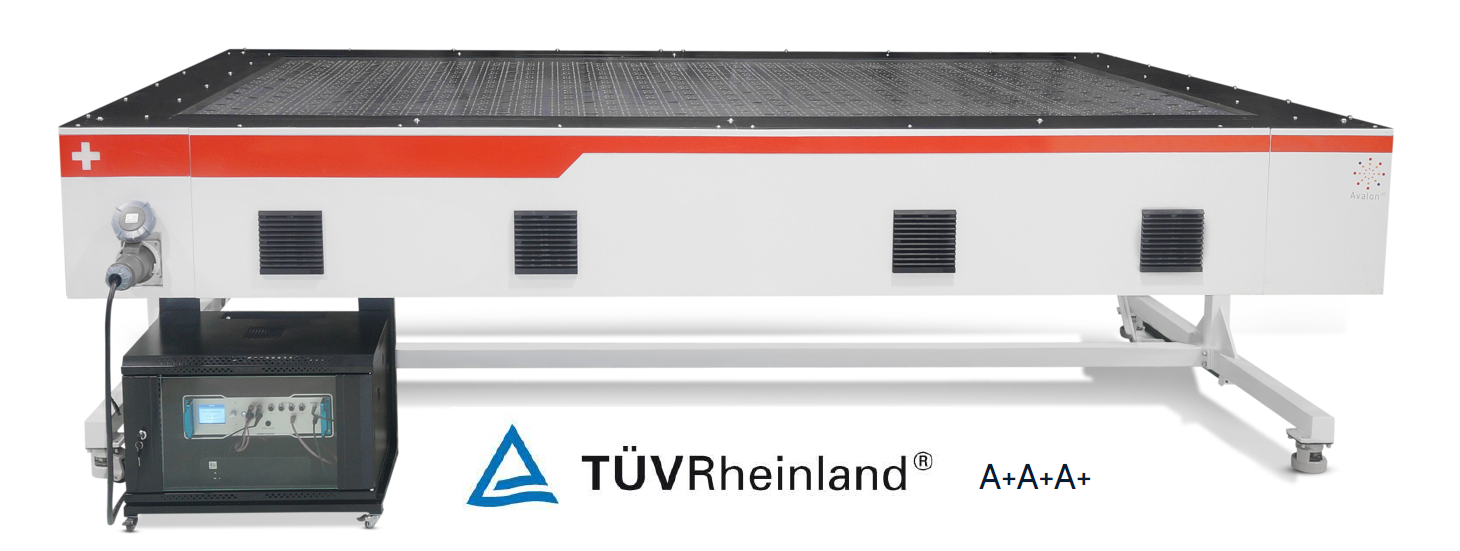
For new laboratories and production lines, full-LED is the default choice: tighter classes (A+++ A++ A+++ on the Nexun ULTRA), lower uncertainty through per-band control, and decisively lower lifetime cost. Where a xenon baseline must be preserved, the group's Pasan systems and Avalon's calibration chain correlate the two so a lab can transition without losing its history.
Frequently asked questions
- Are LED solar simulators better than xenon?
- For new installations, yes in most cases: LED simulators hold tighter IEC 60904-9 classes, deliver long single-sweep pulses for capacitive cells, never drift spectrally, and run 3,000,000 flashes without consumables. Xenon keeps value where decades of correlation history must be preserved.
- Can LED simulators reach xenon-equivalent spectra?
- Yes. Avalon delivered the first xenon-equivalent spectrum on a full-LED large-area system in 2020, and the Nexun ULTRA's integrated spectral deviation (below 20%) is better than a typical xenon flasher.
- Who makes both LED and xenon solar simulators?
- The Avalon ST and Pasan group is the notable case: Pasan has built xenon reference simulators since 1978, and Avalon ST builds the full-LED Nexun line, sharing one calibration chain.
- How do I keep my measurement history when switching from xenon to LED?
- Run a correlation campaign: measure a stable reference set on both instruments and carry the offset into your uncertainty budget. Because Avalon and Pasan share one calibration chain, this transition is a standard, documented procedure on Nexun systems.