Every step up in cell efficiency has come with a step up in junction capacitance. HJT and TOPCon devices store enough charge that the cell cannot follow a fast voltage sweep: measure them with a millisecond-class flash and the I-V curve splits into two curves, one swept up and one swept down, with the true curve somewhere between. The error lands directly on Pmax, the number your contract is written on.
The workarounds, and their cost
Legacy flashers attack the problem with reconstruction: dozens of short flashes at different bias points, stitched into one synthetic curve. It works, at the cost of throughput (60+ flashes per module), added uncertainty from the stitching model, and lamp wear. It is a patch for a light source that cannot hold irradiance long enough.
The actual fix: one long sweep
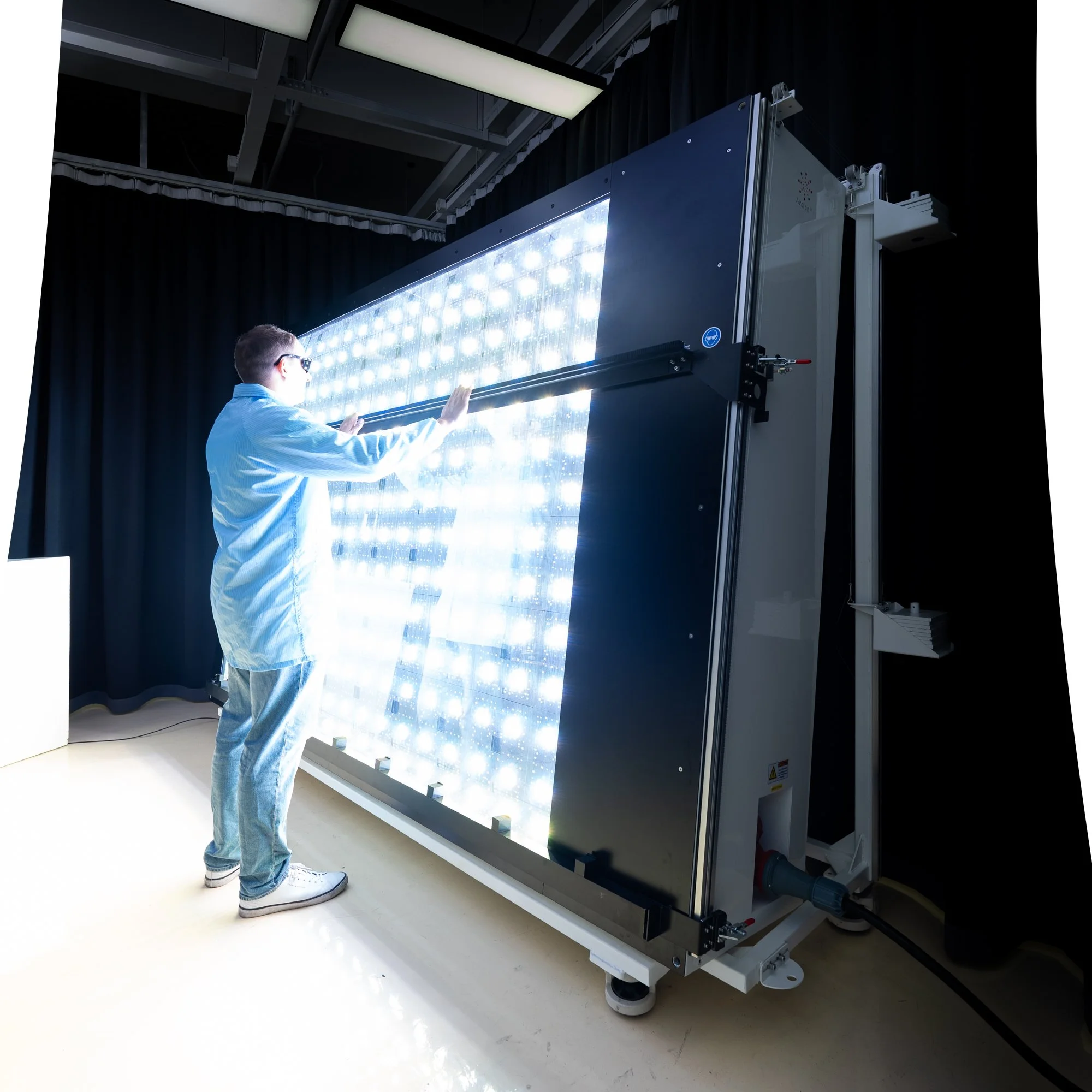
An LED engine holds irradiance constant for as long as the electronics ask. A 500 ms pulse sweeps the entire I-V curve in a single pass, slowly enough that the cell stays in quasi-steady state: no hysteresis, no reconstruction, no model uncertainty. This is native behaviour across the long-pulse Nexun line, with temporal instability held at 0.2% over the full pulse, and it is why a Nexun PRO measures an HJT module in one flash where a legacy flasher needs sixty.
What to specify
- Pulse length around 500 ms with constant irradiance, graded for class over the full pulse.
- Single-sweep I-V acquisition, not multi-flash reconstruction, for both throughput and uncertainty.
- Enough irradiance headroom for bifacial protocols (the Nexun PRO MAX reaches 1300 W/m² peak).
Frequently asked questions
- Why do HJT and TOPCon modules need a long-pulse solar simulator?
- Their high junction capacitance distorts the I-V curve under a fast sweep, misreporting Pmax. A ~500 ms constant-irradiance pulse lets the cell stay in quasi-steady state so the true curve is measured in one sweep.
- What is sweep-rate (hysteresis) error in IV measurement?
- The gap between I-V curves swept in opposite directions on a capacitive cell measured too fast. It signals that the measured power is transient-contaminated; a long single-sweep pulse removes it.
- How many flashes does it take to measure an HJT module?
- On a long-pulse Nexun, one. Legacy short-flash systems need on the order of 60 flashes plus a reconstruction model to approximate the same curve.
- Does a 500 ms pulse hurt production throughput?
- No. One 500 ms flash replaces tens of short flashes, so line takt improves. The production-focused Nexun EVO runs 100 ms pulses where device physics allows, and the line is sized for gigawatt throughput.