A perovskite cell does not have one efficiency; it has a state. Ion migration and trap dynamics mean the device you measure depends on the seconds to minutes of illumination before the sweep. Measure cold and you under-read; soak uncontrolled and you over-read. The instrument has to control light history, not just light quality.
Preconditioning is part of the measurement
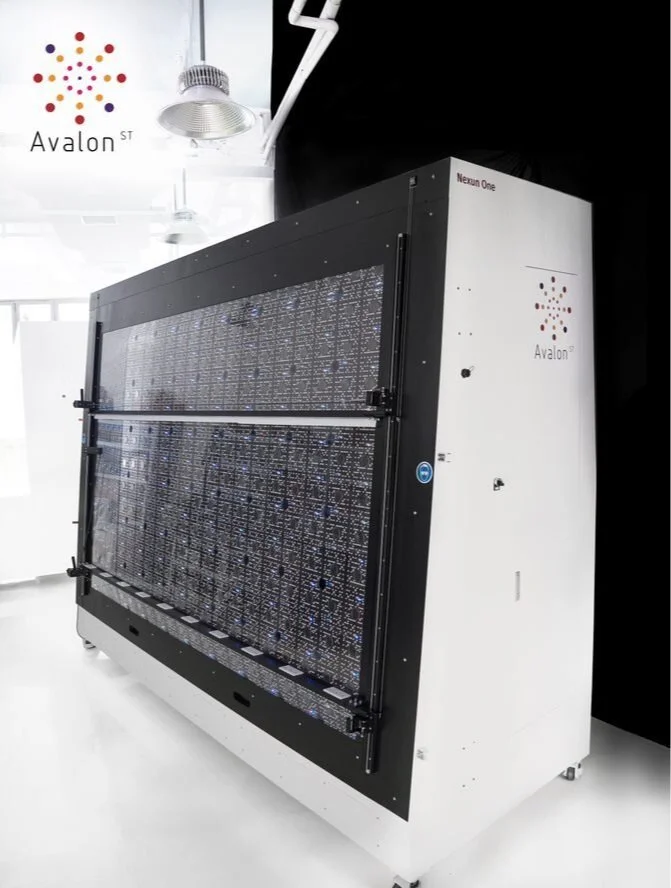
The Nexun Perovskite integrates steady-state preconditioning with the 500 ms measurement pulse on one bench: the cell is held under defined irradiance until it stabilises, then measured in a single long sweep, with the whole sequence scripted and logged. For long-soak protocols and light-induced degradation studies, the steady-state Nexun Steady holds full-spectrum irradiance indefinitely.
Tandems add a spectral problem
A two-terminal tandem is current-limited by whichever junction sees less of its light. Measuring it honestly means setting the spectral balance per band, which is exactly what per-wavelength LED control provides. The Nexun ULTRA switches 37 wavelengths individually in software, so junction-by-junction characterisation and current-matching studies run on the same instrument as the certification measurement. For space multi-junction work, the Nexun Cosmo extends the range to 300 to 1900 nm under AM0.
What a defensible perovskite number requires
- Scripted steady-state preconditioning, logged with the measurement.
- A 500 ms single-sweep pulse so the metastable state is not disturbed mid-curve.
- Per-wavelength spectral control for tandem current matching.
- A stabilisation criterion (MPP tracking until drift falls below threshold), not a fixed soak time.
Frequently asked questions
- What solar simulator do I need for perovskite cells?
- One that combines steady-state preconditioning with a long (≈500 ms) measurement pulse on the same bench, so the cell's metastable state is stabilised and then measured in a single sweep. The Avalon Nexun Perovskite is built around exactly this sequence.
- Why do perovskite cells need preconditioning before IV measurement?
- Their performance depends on illumination history through ion migration and trap filling. Without a defined stabilisation under light, the measured efficiency reflects an arbitrary transient state rather than the device's operating performance.
- How do you measure a perovskite-silicon tandem accurately?
- Current-match the junctions with per-wavelength spectral control, precondition to a stabilised state, then sweep once over ~500 ms. The Nexun ULTRA's 37 individually switchable wavelengths make the spectral part a software setting.
- What is the difference between flash and steady-state testing for perovskites?
- Flash (long-pulse) testing measures a stabilised device quickly and is the certification workhorse; steady-state testing holds irradiance indefinitely for soak, MPP-tracking and degradation protocols. A complete perovskite lab uses both, e.g. Nexun Perovskite plus Nexun Steady.